
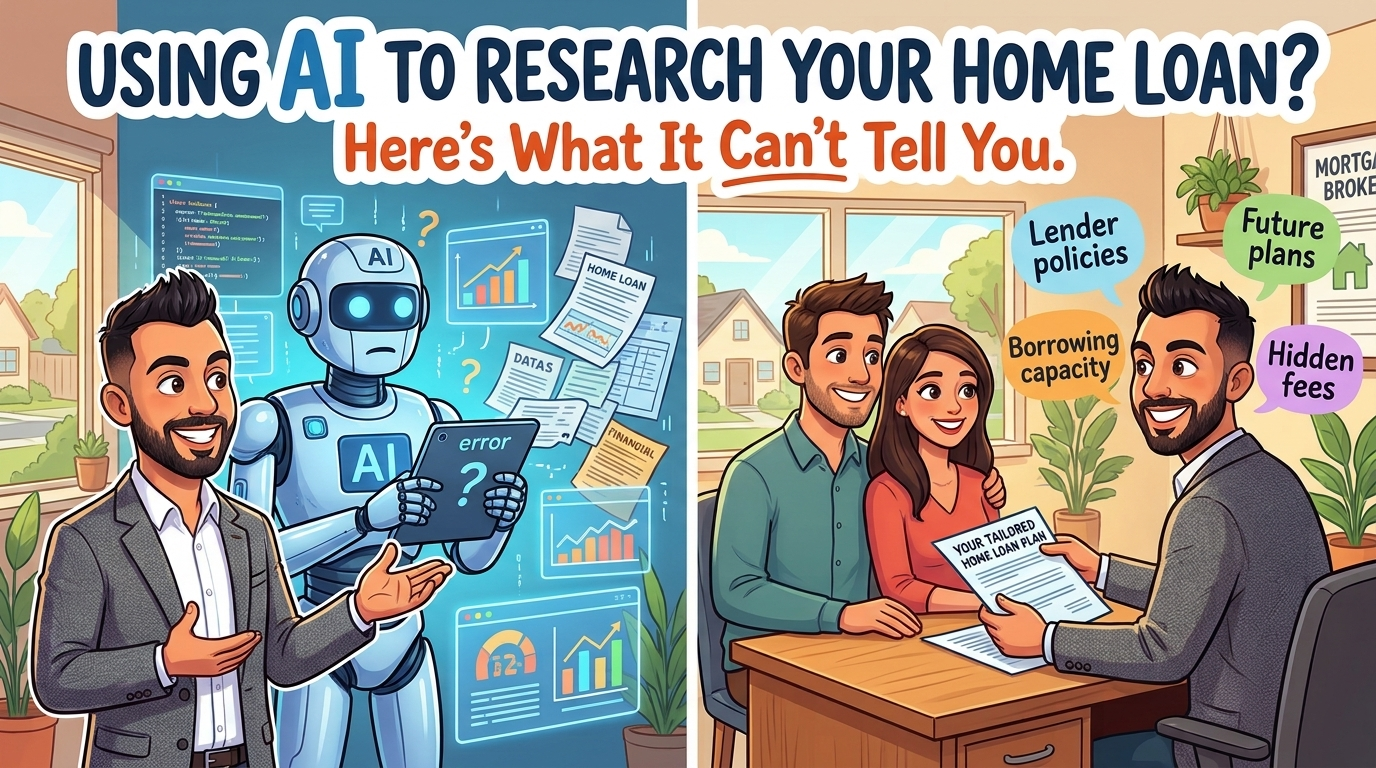
If you've asked ChatGPT how much you can borrow, or got an AI tool to compare home loan rates, you're in good company. More than half of Australians planning to buy a home are now using AI to research their loan options.
But there's a catch. Most of those same buyers don't trust what AI tells them, and for good reason. A home loan is one of the biggest financial decisions you'll make, and the right choice depends on details no chatbot can see.
Here's what the latest research says about how Australians are using AI for home loans, where it helps, where it falls short, and how to get the best of both worlds.
58% of home buyers are already using AI
According to the Mortgage and Finance Association of Australia's (MFAA) Australian Borrower Report 2026, 58% of prospective buyers have used AI during their home buying journey. The YouGov survey covered more than 2,000 Australians planning to buy property within the next three years.
Younger buyers are leading the way. Three in four buyers aged 25 to 34 (75%) have used AI, along with 73% of millennials and 67% of adult Gen Z. Among buyers aged 65 and over, it's just 29%.
Interestingly, people who've used a mortgage broker before are more likely to use AI (64%) than those who never have (53%). AI isn't replacing expert advice. Savvy buyers use it to come better prepared.
What are buyers using AI for?
The MFAA found buyers mostly use AI for early-stage homework:
Estimating borrowing capacity (24%)
Comparing interest rates (24%)
Preparing questions for a mortgage broker (20%)
Checking broker and lender information (19%)
These are sensible uses. AI is quick, available 24/7 and good at explaining jargon like LVR, LMI or offset accounts in plain English.
The trust gap: using AI isn't the same as trusting it
Only 19% of buyers say they'd trust AI as a source of home loan information, and just 4% rank it as their most trusted source. Here's how AI stacks up against other sources:
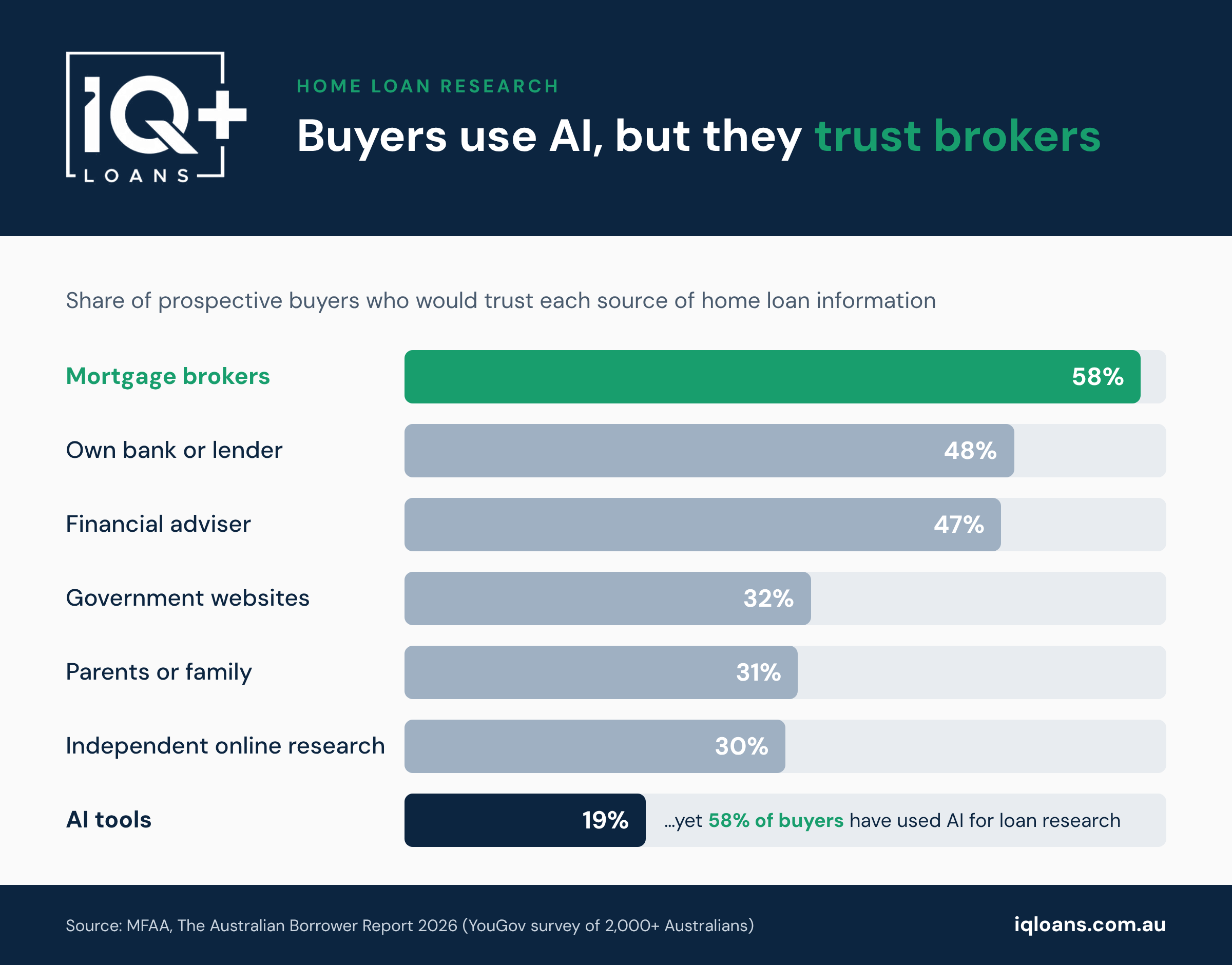
Mortgage brokers also came out on top as the single most trusted source (30%), ahead of financial advisers and banks (15% each). And 82% of buyers who'd used a broker were satisfied with their last experience.
In short, buyers are happy to use AI to get started, but when real money is on the line, they want a person who knows the market.
Where AI falls short on home loans
AI tools are a useful starting point, but they have real blind spots when it comes to your mortgage:
It doesn't know your full situation. Borrowing capacity depends on your income type, debts, expenses, credit history and deposit. Each lender assesses these differently.
Rates and policies change constantly. AI may draw on outdated information, and it can't see lender rate changes, cashback offers or policy updates in real time.
It can't see lender appetite. Some lenders are friendlier to self-employed borrowers, casual workers or buyers with small deposits. This kind of insight comes from working with lenders every day.
It can sound confident and still be wrong. AI can present an estimate as fact. One wrong number can mean applying for the wrong loan, or missing out on a better one.
It can't lodge, negotiate or chase your application. A broker manages the process from pre-approval through to settlement.
Common broker myths, busted
Among buyers who wouldn't use a broker, 28% thought it would cost more and 28% questioned whose interests a broker serves. In reality, brokers are generally paid by the lender, not by you. Brokers are also legally required to act in your best interests under the Best Interests Duty.
How to use AI and a mortgage broker together
MFAA CEO Anja Pannek says buyers "are coming to conversations with more information and questions". Brokers then help them make sense of that research for their own circumstances. Here's how to make that work for you:
Use AI to learn the basics. Ask it to explain loan features, fees and the buying process.
Build your question list. Use AI to prepare questions about rates, loan structure and your borrowing power before you speak to a broker.
Treat AI numbers as rough estimates. Borrowing capacity figures and rate comparisons are a starting point, not a guarantee.
Don't share sensitive details. Avoid entering payslips, tax returns or account numbers into public AI tools.
Get it checked by an expert. A broker can compare options across a panel of lenders and find the right fit for your goals.
As one broker put it, by the time AI-savvy clients reach a professional, it's "usually just confirming the things they already know". That's a great place to start.
Frequently asked questions
Can I use ChatGPT or other AI tools to find a home loan?
Yes, AI is useful for learning the basics and preparing questions. But it can't assess your full financial situation or see live lender policies, so its answers should be checked by a qualified professional.
Is an AI borrowing capacity estimate accurate?
Treat it as a rough guide only. Each lender calculates borrowing power differently, so the amount you can actually borrow may be higher or lower.
Does using a mortgage broker cost more?
In most cases, no. Brokers are usually paid a commission by the lender. Your broker must disclose how they're paid.
Do mortgage brokers have to act in my best interests?
Yes. Mortgage brokers in Australia are legally required to act in their clients' best interests under the Best Interests Duty.
Ready to put your AI research to work?
AI can get you started, but the right home loan comes from expert advice tailored to you. Bring your questions, your AI research and your goals to the team at IQ Loans. We'll compare options across our lender panel and help you move forward with confidence.
Book a free chat with an IQ Loans broker today.
This article is general information only and doesn't consider your personal circumstances.