
Upsizing in 2026: What Australia's Cooling Property Market Means If You're Buying Bigger
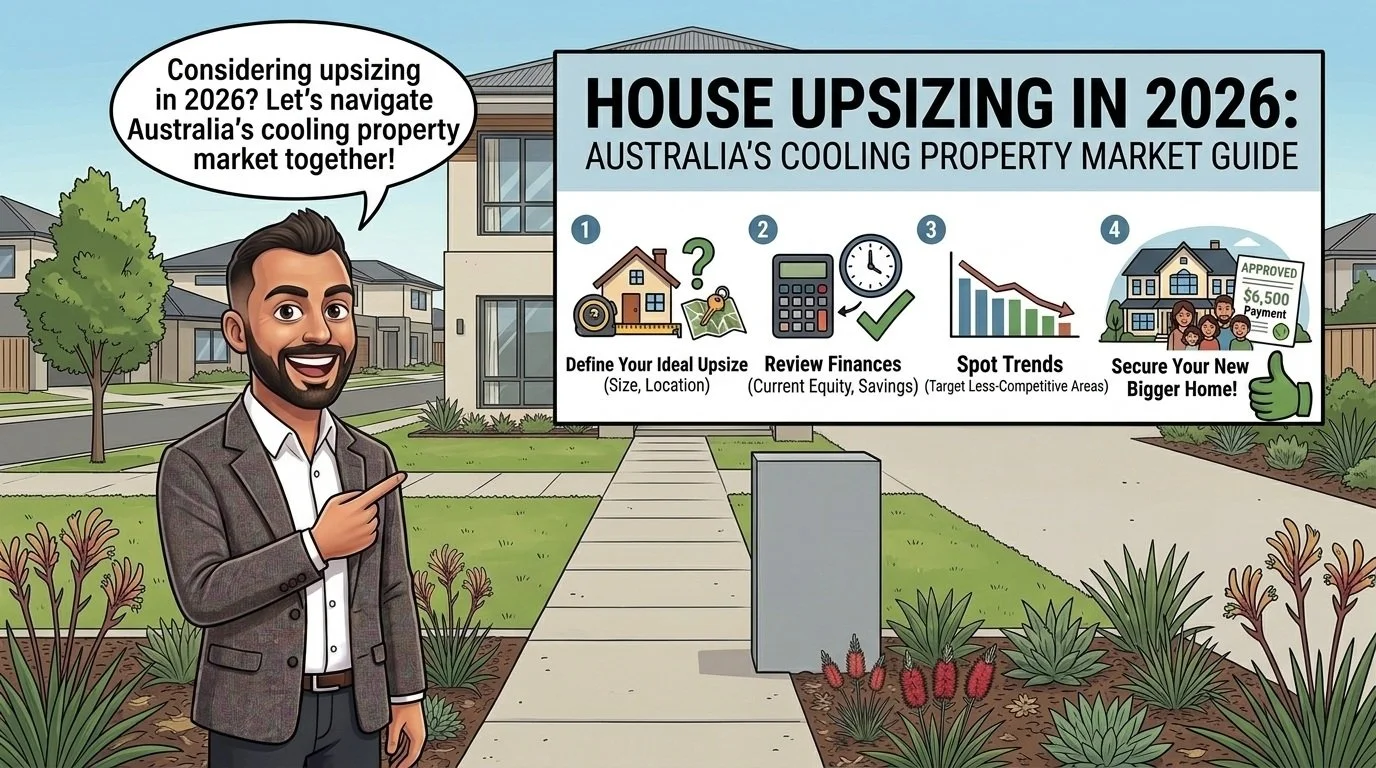
If you've outgrown your home, either a baby made it feel smaller overnight, the home office became permanent, or you're just tired of tripping over everyone, you've probably been watching the market and wondering whether now is a smart time to move up. The honest answer is: it's more nuanced than "prices are falling, so it's a good time" or "rates are high, so wait." Both are true at once, and which one matters more depends on your numbers.
In this guide: what's actually happening in the market right now, why a cooling market can work in an upsizer's favour, the borrowing-power catch that comes with a higher-rate environment, how to structure the move itself, and the costs people usually underestimate.
What's actually happening in the property market right now
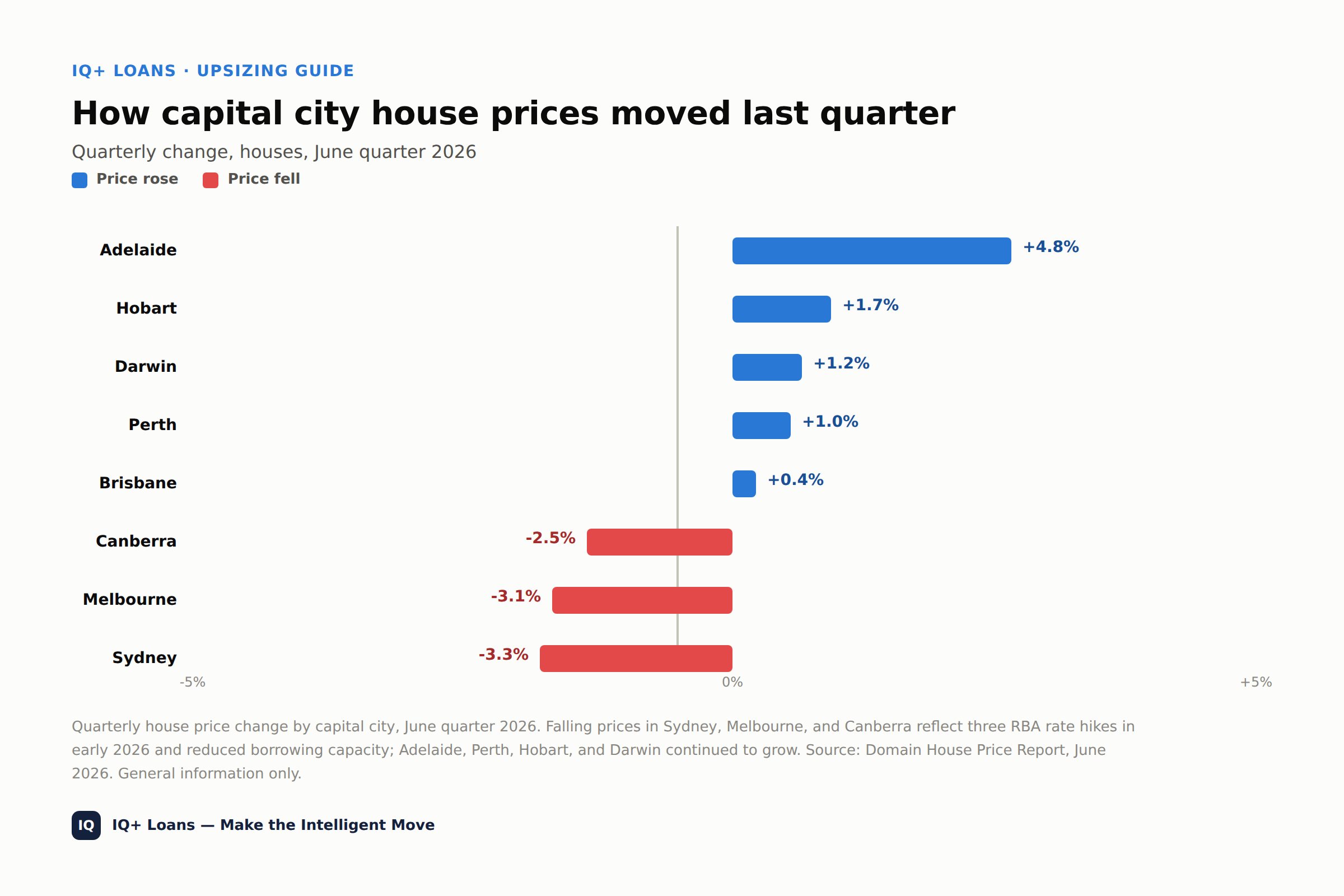
Australia's housing market turned a corner in the June 2026 quarter. Combined capital city house and unit prices fell for the first time in over three years, ending the longest uninterrupted run of quarterly growth since 2012–15, largely a result of three RBA rate hikes in early 2026 that pushed the cash rate to 4.35% and reduced borrowing capacity across the board.
It isn't uniform. Sydney houses fell 3.3% for the quarter (median $1.734m), Melbourne fell 3.1% ($1.041m), and Canberra fell 2.5% ($1.038m). Meanwhile Adelaide bucked the trend entirely, up 4.8% and still accelerating, Perth rose 1.0%, Hobart 1.7%, Darwin 1.2%, and Brisbane edged up 0.4%. Units mostly followed houses down, with investors pulling back noticeably — ABS lending data shows total dwelling loan commitments fell 5.4% in the same quarter, and investor loan commitments dropped even further, down 8.6% in number and 10.2% in value.
For upsizers, the city-by-city split matters more than the national headline. If you're moving within Sydney or Melbourne, you're operating in a genuinely softer market. If you're in Adelaide or Perth, you're upsizing into continued growth.
Why a cooling market can actually work in your favour
Here's the part that surprises people: when prices soften, upsizers are often better placed than first-home buyers or downsizers, because you're both a seller and a buyer in the same market. If your current home's value dipped 3% but the larger home you want dipped by a similar percentage, the dollar gap between them may have narrowed rather than widened, since a percentage fall bites harder in dollar terms on a more expensive property.
A softer market also usually means fewer buyers at open homes, more room to negotiate on price, longer settlement terms if you need them, and vendors who are more willing to accommodate a subject-to-sale offer. None of this is guaranteed. It depends heavily on your specific suburb and price bracket, not just your city's average.
The catch: borrowing power in a higher-rate world
Upsizing almost always means a bigger loan, and that's where the current environment bites. Lenders assess your ability to repay at your actual rate plus a serviceability buffer (typically around 3 percentage points), so at variable rates now sitting in the high-5% to low-6% range, that assessment rate can land near 9%. Three years ago, the same exercise was done against a much lower base rate. The practical effect: your borrowing capacity for the same income has shrunk since you last got a home loan, even if your income has grown.
This is exactly the kind of thing worth checking before you fall in love with a house. A pre-approval based on today's serviceability settings, not what you assumed you could borrow last time, avoids a painful surprise at the pointy end of a purchase.
How to actually structure the move
There are three common paths, and each suits a different risk appetite.
Sell first, then buy. The lowest-risk option. You know exactly what you have to spend once your home sells, but you may need to rent in between, and you're buying under time pressure if you've already got a settlement date.
Buy first, using a bridging loan. A bridging loan lets you buy the new home before your current one sells, using the equity in your existing property. Lenders calculate a "peak debt" (the new purchase plus your existing mortgage) and an "end debt" (peak debt minus your expected sale proceeds). These loans are usually interest-only, run for up to about 12 months, and often carry a higher rate than a standard home loan. If your existing home takes longer to sell than planned, the interest bill can escalate quickly, so a bridging loan works best when you have strong equity and a realistic, well-supported view of what your current home will actually sell for.
Buy and sell simultaneously. The most efficient option on paper, but it requires tightly coordinated settlement dates and a bit of luck, since a delay on either side can leave you exposed.
The costs upsizers tend to underestimate
Stamp duty is the big one. Unlike downsizers, who can access some concessions in certain states, upsizers pay full stamp duty on the new, larger purchase, calculated on a bigger price tag than what you paid for your current home. On top of that: selling agent commission on your existing property, moving costs, and potentially Lenders Mortgage Insurance if the new loan pushes your loan-to-value ratio above 80%, even if you had none on your original loan.
Running the full cost picture before you commit, not just the difference between the two sale prices, is where a lot of upsizers get caught out.
Why talk to a broker before you start inspecting
Getting a realistic, current picture of your borrowing power and equity position before you start looking at homes changes how you shop, you know your real ceiling, whether a bridging loan makes sense for your situation, and what your repayments actually look like at today's rates rather than the ones you locked in years ago.
At IQ+ Loans, we're MFAA accredited, a Commonwealth Bank Elite Broker, and a member of AFCA, with access to 100+ lenders. If you're weighing up whether now's the right time to upsize, we can model your numbers against the current market and lay out your real options.
Ready to see what your upsizing move could look like? Book a call with IQ+ Loans and make the intelligent move.
Frequently asked questions
Is 2026 a good time to upsize with prices falling in some cities?
It depends on your city and price bracket more than the national trend. In Sydney, Melbourne, and Canberra, softer conditions can mean less competition and more room to negotiate on the home you're buying, which can offset a similar dip in what your current home is worth. In Adelaide, Perth, Hobart, and Darwin, prices are still rising, so the dynamic is different. Run your specific numbers rather than relying on headlines.
How much bigger a loan can I actually get right now?
It depends on your income, existing debts, and the lender's serviceability buffer, which is typically your loan's rate plus around 3 percentage points. With variable rates in the high-5% to low-6% range, that assessment can sit near 9%, which reduces borrowing capacity compared to a lower-rate environment. A broker can run an updated borrowing power estimate based on current settings before you start inspecting homes.
Should I use a bridging loan to buy before I sell?
It can work well if you have strong equity in your current home and a realistic, well-supported estimate of its sale price. Bridging loans are usually interest-only and carry a higher rate, and the interest bill escalates the longer your existing home takes to sell, so they suit borrowers with a comfortable equity buffer more than those relying on a fast, best-case sale.
Do I have to pay stamp duty again when I upsize?
Yes. Unlike downsizers, who can access certain state-based concessions, there's generally no equivalent concession for upsizers. Stamp duty applies in full on the new purchase price, which is often the single largest cost people underestimate when budgeting for a move.
What happens to my deposit if I'm upsizing rather than buying for the first time?
Most upsizers use the equity built up in their current home, rather than a separate cash deposit, to fund the purchase, either by selling first and using the proceeds, or via a bridging arrangement that draws on that equity before the sale settles. How much you can access depends on your current loan balance, your home's value, and the lender's loan-to-value requirements.