

he average first home buyer loan in Australia hit $610,063 in June 2026. That's up almost $50,000 (8.9%) since the Government's 5% Deposit Scheme was expanded on 1 October 2025, according to Primara Research analysis of ABS lending data.
The scheme lets eligible buyers purchase with just a 5% deposit and no lenders mortgage insurance (LMI). That's a big win for getting into the market sooner. But a smaller deposit means a bigger loan, and with interest rates rising through 2026, it's worth understanding the full trade-off before you sign.
In this guide, we explain what the numbers mean for you as a first home buyer, and how to decide whether the 5% deposit path is right for your situation.
What changed with the 5% Deposit Scheme?
From 1 October 2025, the Government's 5% Deposit Scheme (formerly the First Home Guarantee) became far more accessible. Three key changes opened it up to many more first home buyers:
No income caps. Previously, singles earning over $125,000 and couples over $200,000 were excluded.
No cap on places. There's no longer a limited number of spots each year.
Higher property price caps. Caps were lifted in most capital cities. In Western Australia, for example, the cap jumped from $600,000 to $850,000.
Under the scheme, the Government guarantees part of your loan. This means you can buy with as little as 5% deposit without paying LMI, which can otherwise cost tens of thousands of dollars.
Why first home buyer loan sizes are rising
The expansion has lifted loan sizes much more than it has lifted the number of buyers. In the December 2025 quarter alone, average first home buyer loans jumped 8.5%, the strongest quarterly rise since Primara's series began in 2002.
Here's how first home buyers compare with the rest of the market:
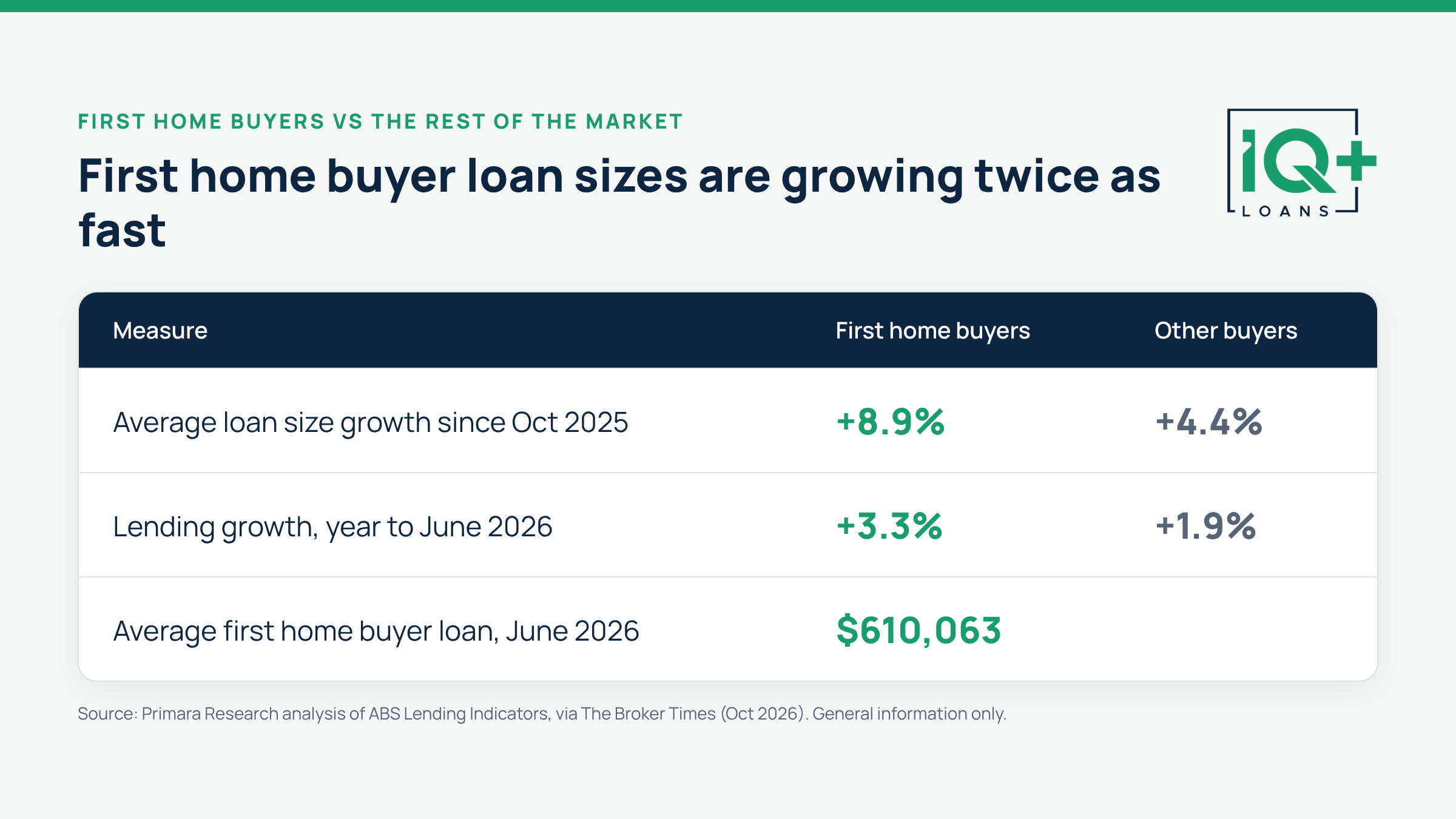
Yet the number of first home buyer loans hasn't grown. Seasonally adjusted, it sits 2.3% below the quarter before the expansion. ABS figures show 29,319 first home buyer owner-occupier loans in the June 2026 quarter, flat on a year earlier, while the total value rose 10% to $18.4 billion.
In plain terms: roughly the same number of people are buying, but they're borrowing more. Higher price caps let buyers stretch to dearer homes, and a 5% deposit means more of the price is borrowed. Western Australia shows this most clearly, with loan sizes up 16% even as buyer numbers fell.
The 13.7-year break-even: what it really means
Primara estimates it takes about 13.7 years of extra repayments to "use up" the upfront benefit of buying with a 5% deposit instead of 20%.
Here's the simple version of the maths:
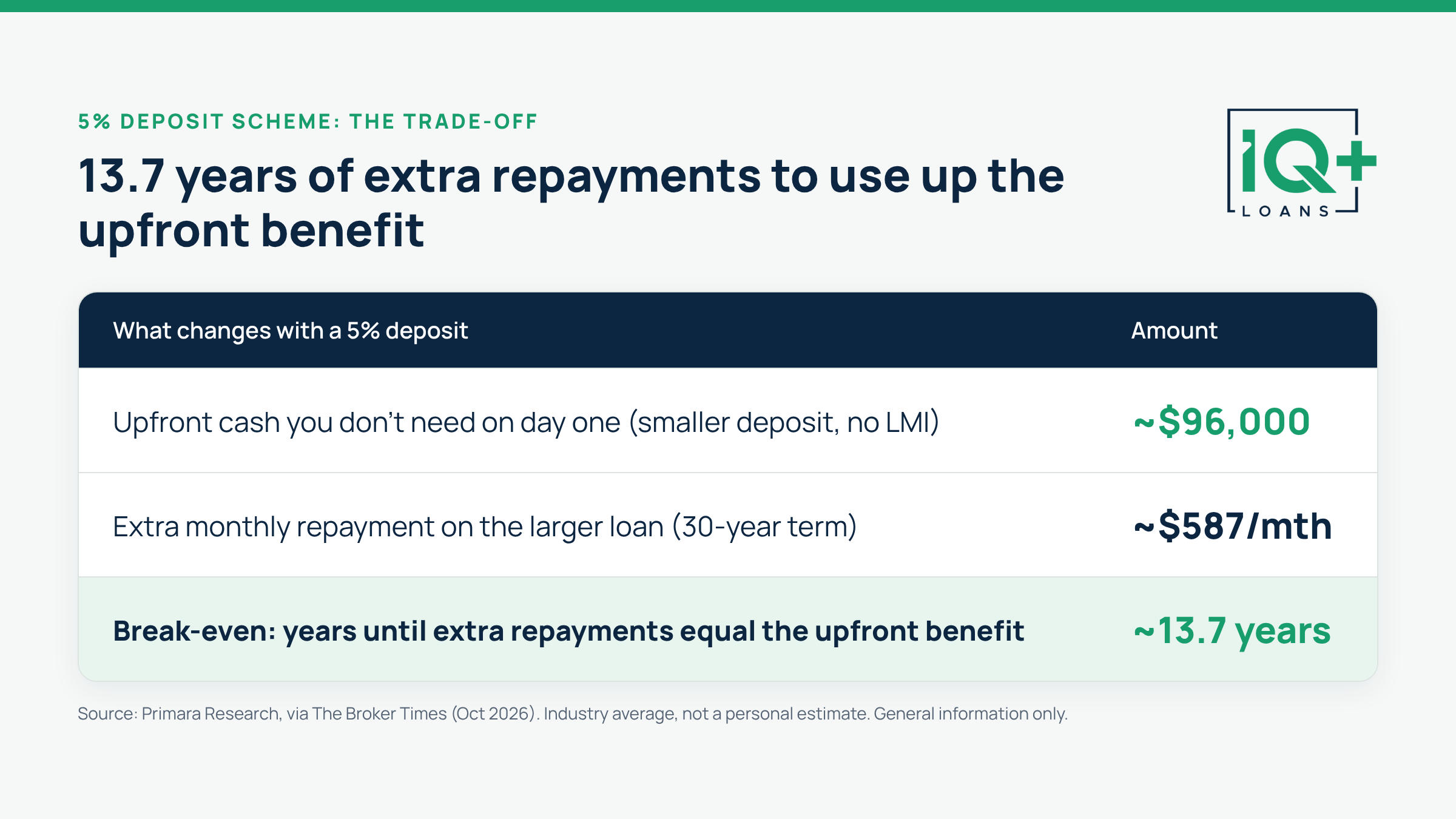
In other words, the scheme saves you roughly $96,000 at the start, but costs you around $587 more every month. That's about $7,000 a year in extra repayments.
Rising rates have made this trade-off tougher. The Reserve Bank lifted the cash rate to 4.60% on 29 September 2026, its fourth increase this year. Primara says rate rises since October 2025 have already eroded more than a third of the scheme's upfront benefit.
Keep in mind: 13.7 years is an industry-wide average, not your personal outcome. It doesn't factor in the rent you save by buying sooner, property price growth while you'd otherwise be saving, or paying extra into an offset account. Your own numbers could look very different, better or worse.
Is the 5% Deposit Scheme right for you?
There's no one-size-fits-all answer. It depends on your goals, your budget and how quickly the market is moving where you want to buy.
The scheme may suit you if:
Saving a 20% deposit would take years while prices keep climbing
You're paying high rent that could go towards your own home
You plan to stay in the property long term
Your budget comfortably handles the higher repayments, with a buffer for further rate rises
It may pay to wait or save more if:
You're close to a larger deposit already
The higher repayments would stretch your budget
You expect to sell or move within a few years
You'd rely on future pay rises to keep up with repayments
As Primara's Head of Research Peter Drennan put it: "An extra $587 a month changes how a new homeowner budgets, and rising rates only make that harder to plan around."
5 tips for first home buyers in a rising-rate market
Stress-test your repayments. Check you could still afford your loan if rates rose another 0.5% to 1%.
Refresh old pre-approvals. If your pre-approval was issued before the September 2026 rate rise, your borrowing power may have changed. Have it reviewed before you bid.
Compare both paths side by side. Ask your broker to model a 5% deposit loan against waiting and saving a bigger deposit, using your own income, rent and timeframe.
Think about how long you'll stay. The longer you hold the property, the more the upfront benefit and capital growth can work in your favour.
Use an offset account. Keeping any spare savings in an offset can reduce the interest on your larger loan without locking the money away.
Frequently asked questions
What is the average first home buyer loan in Australia?
As of June 2026, the average first home buyer loan is $610,063, up around $49,800 since October 2025 (Primara Research, based on ABS data).
Do I pay LMI with the 5% Deposit Scheme?
No. Eligible buyers can purchase with a deposit as low as 5% without paying lenders mortgage insurance, because the Government guarantees part of the loan.
Are there income limits for the 5% Deposit Scheme?
Not anymore. Income caps were removed from 1 October 2025, along with the cap on the number of places. Property price caps still apply and vary by location.
How long does it take for the 5% deposit to "break even"?
Primara's estimate is about 13.7 years, based on roughly $96,000 less cash upfront against about $587 more in monthly repayments. Your own break-even depends on your loan, rate, rent and how long you hold the property.
Should I use the scheme or save a 20% deposit?
It depends on how long saving would take, what you pay in rent, how prices are moving in your area and whether your budget can absorb higher repayments. A mortgage broker can model both options for your situation.
Get personalised advice from IQ Loans
The 5% Deposit Scheme can be a powerful way into the property market, but the right choice depends on your numbers, not the national average. At IQ Loans, we'll compare a 5% deposit loan with your other options, stress-test your repayments and help you find a loan that fits your budget today and down the track.
Ready to find out where you stand? Book a free chat with an IQ Loans broker today.
This article contains general information only and does not take into account your objectives, financial situation or needs. Consider whether it is appropriate for you and seek personalised advice before making any financial decision. Eligibility criteria, price caps and lender policies apply to the 5% Deposit Scheme.