
How Rate Rises Have Cut Your Borrowing Power in 2026 (and What to Do About It)

If you're planning to buy, your home loan borrowing power has likely shrunk in 2026, even if nothing about your finances has changed. In late September the Reserve Bank lifted the cash rate by 0.25 percentage points to 4.60%, its fourth rise of 2026 and a full 1 percentage point higher than in January.
Most headlines focus on higher repayments for people who already have a mortgage. For first home buyers and anyone still shopping with a pre-approval, the bigger issue is how much a lender will now let you borrow.
How do interest rate rises affect borrowing power?
Lenders don't test your application at the rate you'll actually pay. Under APRA's serviceability buffer, they generally check that you could still afford repayments at a rate at least 3 percentage points higher.
So when your actual rate rises by 1 point, the rate you're tested at rises by 1 point too. A higher test rate means a smaller maximum loan. As a rough guide, every 1 percentage point increase can trim around 8–10% off your maximum borrowing, though results vary by lender and situation.
The Reserve Bank's own research backs this up: it found a 0.5 point rise in the assessment rate can cut maximum loan size by up to 5%.
How much less can you borrow after four rate rises?
In this example, a buyer's maximum loan falls by about $68,000 with no change to their income, expenses or deposit. Take a buyer who, in January, could borrow up to $800,000 over 30 years:
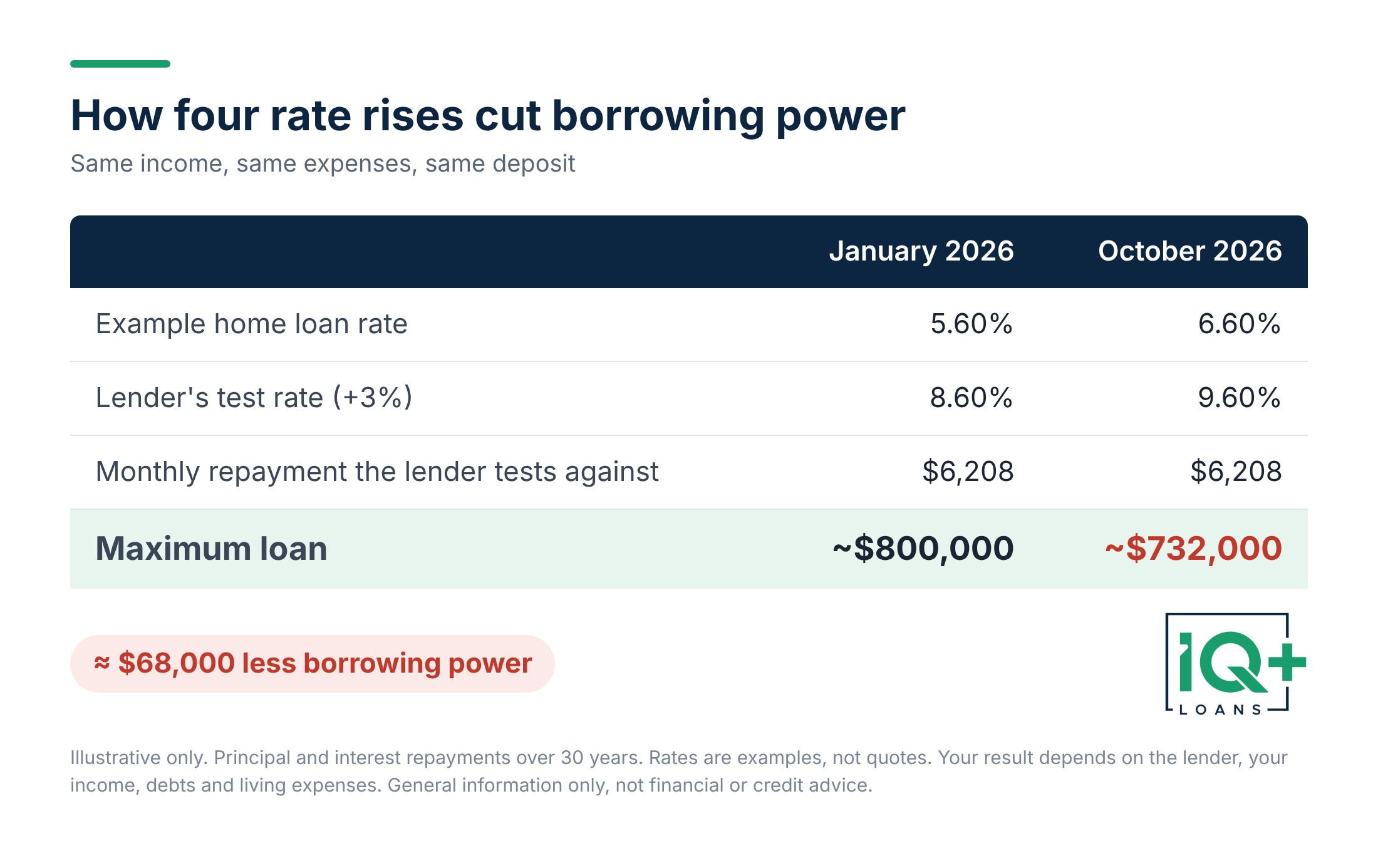
Same person, same pay packet, same savings. Roughly $68,000 less to spend on a home.
Illustrative only, using principal and interest repayments over 30 years. Rates are examples, not quotes. Your own result depends on the lender, your income, debts and living expenses.
Is your home loan pre-approval still safe after a rate rise?
A pre-approval is not a guarantee. If rates or a lender's policies change before you sign, your final approval can come in lower than your pre-approval.
That's most dangerous at auction. Auction contracts are unconditional, so if you bid to a figure your lender no longer supports, there's no cooling-off period to get out.
5 ways to increase your borrowing power in 2026
Recheck your pre-approval. If it was issued before the latest rise, ask your broker to re-run your numbers at today's rates before you bid or make an offer.
Clear small debts and unused credit. Lenders count your credit card limit, not your balance. Closing an unused card or paying off a car loan can lift borrowing power.
Tidy up your spending. Lenders review recent bank statements. Cutting subscriptions and discretionary spending in the months before you apply helps.
Look wider, not just cheaper. A townhouse, unit or a suburb one ring further out may get you more home for the same budget than chasing a lower price on the same type of house.
Compare lenders. Lenders assess income, expenses and buffers differently. The gap between what one lender and another will approve can be significant.
Borrowing power FAQs
How much does a 1% rate rise reduce borrowing power? As a rough guide, around 8–10% of your maximum loan. On an $800,000 limit, that's about $68,000–$80,000, depending on the lender and your circumstances.
What is the serviceability buffer? It's the extra margin lenders add when testing your loan. APRA expects lenders to check you could afford repayments at least 3 percentage points above your actual rate.
Can my pre-approval be reduced? Yes. A pre-approval is conditional. If rates or lender policies change before final approval, the amount can be lowered, so recheck it before an auction or offer.
How can I increase my borrowing power? Reduce or close credit cards, pay down personal and car loans, trim discretionary spending, and compare lenders, since each assesses income and expenses differently.
Find out how much you can borrow today
Rates may keep moving, but you can plan for it. A quick borrowing power review shows what lenders will approve today, across a range of lenders, before you fall in love with a property.
Book a free borrowing power check with IQ Loans → BOOK A CALL
This article is general information only and does not consider your objectives, financial situation or needs. It is not financial or credit advice.