
First Home Buyers and Upsizers in 2026: Reading Australia's Cooling Property Market

Spring usually brings a rush of "for sale" boards and open-home queues. This year it's bringing something else: a housing market in its fifth straight month of falling values, buyers who've regained the upper hand, and two very different groups - first home buyers and upsizers, trying to work out whether that's good news or bad news for them.
The honest answer is: it depends which side of the transaction you're on, and how well you understand what's actually happening beneath the headlines.
First home buyer and upsizer sentiment in today's market
Confidence is the story right now, more than affordability. Cotality's national Home Value Index fell 0.9% in August, the fifth consecutive monthly decline, leaving values 3.6% below their March 2026 peak. Cotality research director Tim Lawless summed up the shift bluntly: "What started as concentrated easing has become much more generalised softening," adding that "longer selling times, larger discounting and persistently low clearance rates all point to a buyer's market, yet buyers lack confidence."
That last point matters. Auction clearance rates have slid from around 66% in February to the low 40% range by late July, and homes are taking a median of 35 days to sell, up from 27 days not long ago. Vendor discounting has widened to roughly 3.8% nationally, close to a three-year high. On paper, that's a buyer's market. In practice, plenty of first home buyers and upsizers are sitting on their hands, uncertain whether prices have further to fall or whether rates are about to move again.
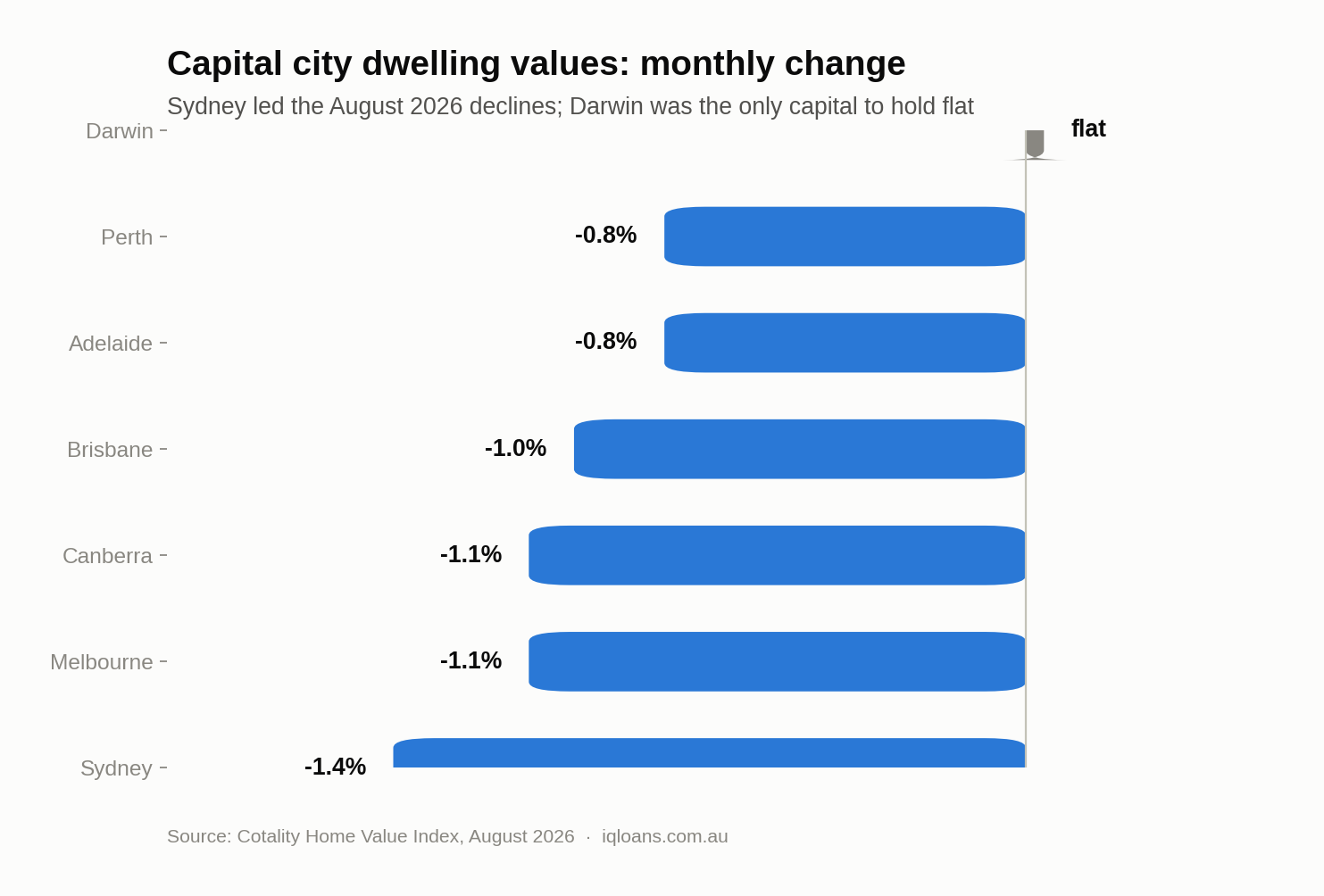
The softening isn't even across the country, either, Sydney has led the latest round of falls, while Darwin is the only capital that hasn't budged.
That hesitation is playing out differently for the two groups.
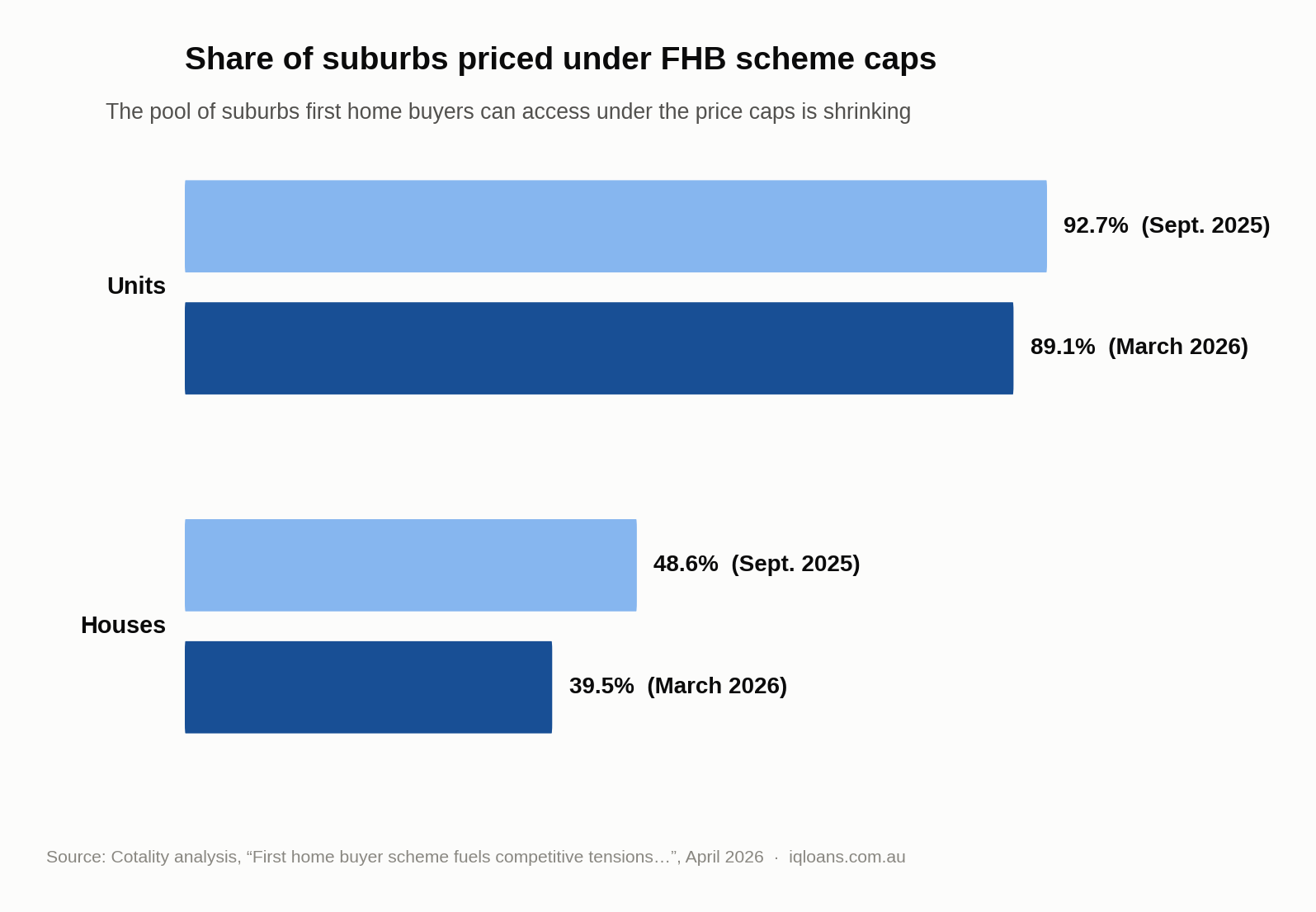
First home buyers are more active than caution alone would suggest, but they're being funnelled into an increasingly narrow slice of the market. The federal government's expanded 5%-deposit, no-LMI home guarantee has been a magnet for entry-level demand since being widened, and Cotality's analysis found that dwellings priced below the scheme's price caps rose 6.7% in value since October, compared with 3.6% for everything above the caps, a gap of over 3 percentage points that widens to 5.2 points in Sydney. The catch: the pool of suburbs where the median house value still sits under those caps shrank from 48.6% of the country in September to just 39.5% by March. In other words, the scheme is working, but its own success is pricing itself out of more and more suburbs.
Upsizers are watching a different set of numbers. Long-term owners are sitting on genuinely large gains, but as we'll get to, that wealth was built in a different market to the one they're about to buy back into.
What the data is actually saying about the 2026 property market
A few figures worth sitting with:
Average first home buyer loan sizes rose 7.7% to $606,400 in the December quarter — a reminder that "affordable" is relative, and that scheme settings alone don't solve serviceability.
The Reserve Bank's cash rate sits at 4.35% after three hikes between February and May 2026, and held for a second straight meeting in August. Governor Michelle Bullock has signalled the Board "retains a tightening bias," with markets still pricing roughly a 60% chance of one more hike by March 2027. A half-percentage-point rate rise cuts borrowing capacity by around $34,300 for someone on $100,000 income — a meaningful hit for a first home buyer stretching to a maximum loan.
Investors made up around 40% of mortgage demand recently, well above the historical one-third average, meaning first home buyers aren't just competing with each other for entry-level stock — they're competing with a larger-than-usual pool of investors chasing the same properties.
For upsizers, Cotality's resale analysis found 96.0% of resales delivered a profit in the March 2026 quarter, the highest share since 2005, with a record median gain of $377,000. But Cotality's Gerard Burg was careful to frame that as a look in the rear-view mirror: those results "largely reflect value growth accumulated over recent years rather than current market conditions," and he expects declining values to "erode profitability in the coming months." The people most exposed right now are recent buyers — those who purchased near the market's 2021-22 peak and are selling after a short, roughly 4.3-year hold, versus the 9.1-year average hold behind the profitable resales.
Regional and lifestyle markets are behaving differently again. Regional dwelling values fell just 0.1% over the three months to July versus a much steeper drop across the capitals, though Cotality's Gerard Burg notes even regional outperformance is now moderating, with demand gravitating toward affordable inland centres such as Dubbo, Tamworth and Albury-Wodonga rather than the premium coastal markets that led the last cycle.
Where the opportunities actually are for first home buyers and upsizers
For first home buyers, the opportunity isn't necessarily in the suburbs the scheme was designed around — it's in recognising that those suburbs are getting more competitive, not less, and adjusting the search accordingly. Outer-metro and regional markets, and units rather than houses, are where genuine value remains under the price caps. Just as importantly, a softening market with longer selling times and wider vendor discounts is one of the few times in years where a first home buyer can actually negotiate on price, rather than bidding against ten other buyers at auction. The trade-off is serviceability: with the cash rate still elevated and a further move not ruled out, getting pre-approval that's genuinely stress-tested — not just approved on today's rate — matters more than ever.
For upsizers, the opportunity is the flip side of the same coin. If you've owned your current home for close to a decade, you're very likely sitting on substantial, genuine equity — even if the market has cooled in the last five months. Selling into a softer market isn't necessarily a loss if you're buying back into that same softer market: a smaller discount on your sale price can be more than offset by a larger discount on your purchase price, particularly in Sydney and Melbourne where the correction has been sharpest. The falling clearance rates and rising days-on-market that make vendors nervous are the exact conditions that hand negotiating power to the buyer you become the moment your own sale settles
Frequently asked questions
Is now a good time to buy a first home in Australia? It depends on the suburb more than the national headlines. Prices are softening nationally and buyers have more negotiating power than they've had in years, but entry-level stock under First Home Guarantee price caps is still competitive because so many buyers are chasing it. Getting genuinely stress-tested pre-approval, not just an estimate, is the key first step.
What is the First Home Guarantee price cap, and why does it matter? The First Home Guarantee lets eligible buyers purchase with as little as a 5% deposit and no lenders mortgage insurance, but only on properties priced under a cap that varies by state and region. As of March 2026, only 39.5% of suburbs nationally had a median house value under that cap, down from 48.6% in September — so where you look matters as much as how much you can borrow.
Should I upsize now or wait for the market to fall further? Waiting for the "bottom" is risky because you're trying to time both your sale and your purchase in the same falling market. If you've owned your current home for close to a decade, you likely have substantial equity, and a softer market with less competition can make it easier, not harder, to secure your next home at a fair price.
How much can rising interest rates affect my borrowing power? Meaningfully. A half-percentage-point rate rise can cut borrowing capacity by roughly $34,300 for someone earning $100,000, enough to push a property out of reach. With the Reserve Bank holding a tightening bias into 2027, getting your numbers modelled against a buffer, not just today's rate, is essential.
Why this is a moment for advice, not guesswork
Scheme price caps, serviceability buffers tested against a still-elevated cash rate, and a market where the "right" suburb keeps shifting month to month — this is precisely the environment where a broker earns their keep. Whether that's structuring a loan so a first home buyer qualifies comfortably under a guarantee scheme's caps, timing a sale-and-purchase so an upsizer isn't carrying two mortgages, or simply reading which lenders are genuinely competitive on servicing right now versus which are pulling back, the difference between a good outcome and a stressful one usually comes down to the advice behind the numbers.
If you're weighing up a first purchase or a move to a bigger home in this market, it's worth talking it through before you start inspecting. The team at IQ+ Loans can model your actual borrowing capacity against current rates, check what you'd genuinely qualify for under first home buyer schemes, and help time a purchase or upsize around your real financial position, not just the headlines.
This article is general information only and doesn't take into account your personal financial situation. Speak with an IQ+ Loans mortgage broker for advice tailored to your circumstances.