
Property Investors in 2026: What Australia's Cooling Market Really Means

If you've been half-watching the property headlines this year, you'd be forgiven for thinking investors should be running for the exits. National dwelling values have fallen for five straight months, clearance rates have collapsed, and vendor discounting is at a three-year high. Yet the data tells a more interesting story: investors haven't been pulling back at all. They've been getting more active, not less, and the reasons why say a lot about where the real opportunities sit right now.
Property investor sentiment: cautious, but not backing away
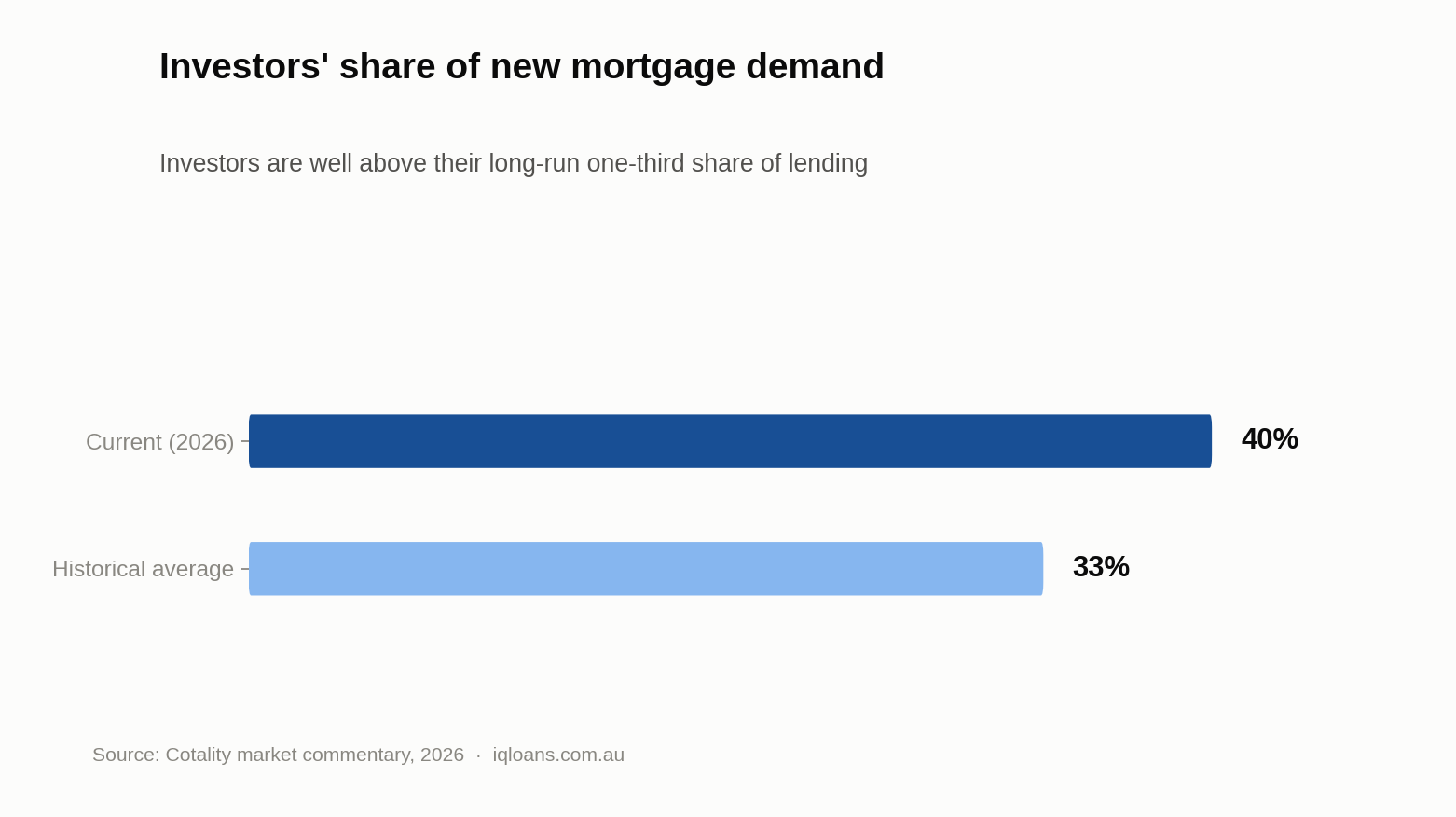
Investors currently make up around 40% of new mortgage demand, well above the historical one-third share they've typically held.
That's a striking figure in a market where Cotality research director Tim Lawless describes conditions as "much more generalised softening" than earlier in the cycle, with "longer selling times, larger discounting and persistently low clearance rates" pointing to a genuine buyer's market. Auction clearance rates have fallen from around 66% in February to the low 40% range, and homes are sitting on the market for a median of 35 days, up from 27.
Rather than reading that as a red flag, a meaningful share of investors appear to be reading it as an entry signal. LJ Hooker's head of growth, Matthew Tiller, makes the case plainly: "by the time everyone agrees that the market has turned, it usually has, and you've missed that peak." His advice to stop trying to time the top or bottom of the cycle and instead focus on the fundamentals of individual suburbs and micro-markets is showing up in how sophisticated investors are actually behaving, buying into softness rather than waiting for a bottom that's only obvious in hindsight.
That said, "active" doesn't mean uncritical. Arjun Paliwal, CEO of buyer's agency InvestorKit, is urging investors mid-cycle to run a genuine portfolio health check rather than simply accumulating: "Retirement isn't determined by owning five, 10 or 20 properties. It's determined by whether your portfolio generates enough income and equity to fund the lifestyle you want." His research found stark divergence in outcomes for properties with similar headline growth, two markets both delivering roughly 7.1% annualised growth produced monthly cash flow gaps of $238 versus $1,985 once holding costs were factored in. Growth alone doesn't tell the whole story.
What the property investment data is actually saying
The numbers paint a market that rewards selectivity far more than it rewards simply "being an investor":
Only 0.8% of Australian suburbs currently offer a genuinely positive cash flow property, and mortgage costs now account for roughly 71% of total holding costs on a typical investment loan. National gross rental yields sit at 3.7%, with the average investor loan rate around 6.34%, a gap that keeps most properties negatively geared in practice, not by choice.
Rental growth remains strong at 5.9% annually, comfortably outpacing wage growth of 3.3%, and vacancy rates are sitting at a record-low 1.5–1.6% nationally. Cotality's Gerard Burg notes tenants are "left with very little leverage" in this environment, good news for landlords' rental income, though he flags that affordability ceilings will increasingly cap how much further rents can climb.
Suburb selection is doing more work than ever: Cotality's analysis found homeowner-dominated suburbs have delivered up to $148,000 more in capital gains than investor-heavy areas over the same period, a reminder that where an investor buys, and who else is buying there, materially shapes long-run returns.
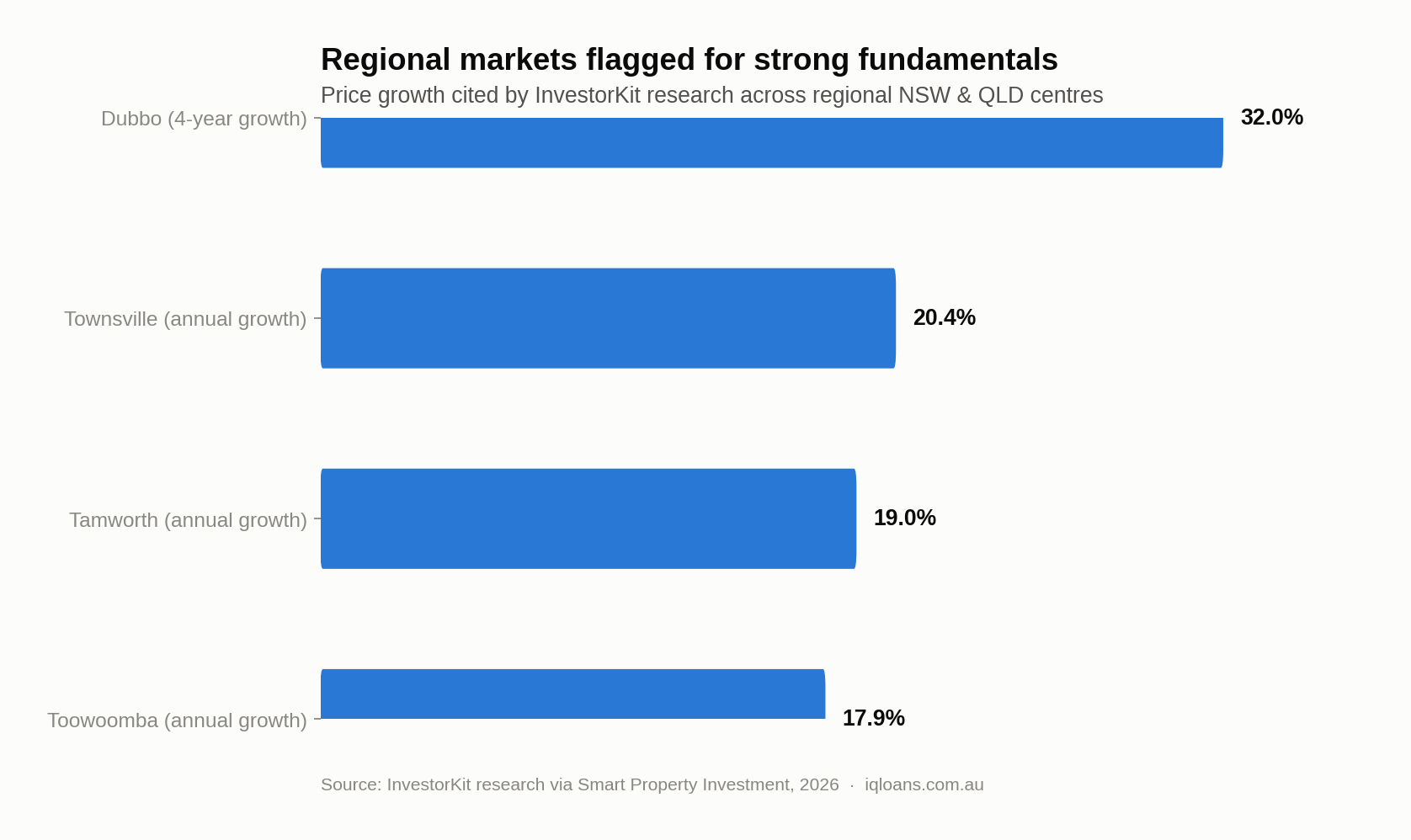
Regional markets continue to offer a yield advantage, averaging 4.2% gross versus 3.6% across the capitals, and Paliwal's research points to specific markets with strong underlying fundamentals right now, including Dubbo (32% price growth and 33% rental growth over four years), Toowoomba, Townsville, Tamworth, Wagga Wagga, Bendigo, Geelong and Newcastle among others.
On the policy front, the federal Budget's removal of negative gearing for purchases of existing housing stock, is a genuine structural shift rather than noise.
Where the property investment opportunities actually are
The clearest opportunity in today's market isn't a suburb, it's negotiating leverage. Wider vendor discounts, longer selling times and softer clearance rates mean investors who are pre-approved and ready to move can secure better prices and terms than they could twelve months ago, particularly in Sydney and Melbourne where the correction has been sharpest. Cotality's own resale data shows 96.0% of resales were profitable in the March 2026 quarter, a record, but with a clear warning attached: recent buyers who purchased near the 2021–22 peak and are selling after a short hold are the ones exposed to loss, while long-term holders continue to do well. That's a useful lens for entry timing too, investors buying now, at values already 3.6% below the March 2026 peak, are starting from a more reasonable base than those who bought at the top.
Yield-focused opportunities are concentrating regionally rather than in the capitals, particularly in inland centres with genuine population and employment drivers rather than short-term lifestyle appeal. And with the 1 July 2027 negative gearing deadline for existing stock now on the calendar, new-build and off-the-plan purchases are worth serious consideration for investors planning to hold past that date, both to get ahead of any change in the rules and because construction-linked purchases sidestep some of the fiercest competition currently coming from first home buyers and owner-occupiers in the established-home market.
Frequently asked questions
Is 2026 a good time to invest in property in Australia? It's a mixed picture. National values are falling and clearance rates are soft, which hands negotiating power to buyers — but yields remain historically low (3.7% gross nationally) and only 0.8% of suburbs offer a positive cash flow property. It favours selective, well-researched investors over anyone simply "getting into the market."
What is happening to negative gearing in Australia? The federal Budget has removed negative gearing for purchases of existing housing stock from 1 July 2027, creating a genuine deadline for investors who want to buy established property under current settings. How new-build and off-the-plan purchases will be treated beyond that date is still developing, so specific, current advice matters more than general commentary here.
Which Australian cities have the best rental yields? Darwin (6.1% gross) and Hobart (4.4%) currently lead the capitals, well ahead of Sydney (3.3%), which remains the tightest yielding market. Regional areas average 4.2% gross versus 3.6% across the capitals combined, though yield alone doesn't guarantee cash flow once holding costs are factored in.
Should investors wait for the property market to bottom out? Most experienced commentators advise against it. As LJ Hooker's Matthew Tiller puts it, by the time a market bottom is obvious to everyone, it has usually already passed. Focusing on individual suburb fundamentals, population growth, supply constraints, employment drivers, tends to outperform trying to time the national cycle.
Why this is a moment for advice, not guesswork
None of this is a case for buying anything, anywhere. It's a case for buying the right asset, structured the right way, ahead of a real policy deadline and inside a market that's actually handing back some negotiating power for the first time in years. Getting the loan structure right, interest-only versus principal and interest, which lender is actually competitive on investor servicing right now, and how a purchase fits against your broader portfolio and borrowing capacity, matters as much as the suburb you choose.
If you're weighing up your next purchase, refinancing an existing portfolio, or want to understand exactly how the 2027 negative gearing changes affect your plans, it's worth getting the numbers modelled properly before you act. The team at IQ+ Loans can review your borrowing capacity, compare lenders on investor servicing, and help structure your next purchase, or your existing portfolio, around where the market genuinely sits today.
This article is general information only and doesn't take into account your personal financial situation. Speak with an IQ+ Loans mortgage broker for advice tailored to your circumstances.
Sources: Cotality Australia — Home Value Index and Monthly Housing Chart Pack (August 2026); "Housing downturn spreads as 93% of capital city suburbs record winter value falls"; "Positive cash flow property a 'needle in a haystack'"; "Homeowner-dominated suburbs deliver up to $148,000 more in capital gains than investor-heavy areas"; "Homeowners pocket record gains even as property market momentum cools"; "Rental growth accelerates annually as Perth and Brisbane close the gap to Sydney"; "RBA holds for a second straight meeting, but cuts remain a distant prospect" (cotality.com.au). Smart Property Investment — "Spring portfolio reset: the health check every investor should complete" (Arjun Paliwal, InvestorKit); "Waiting for the 'perfect' moment to invest? It could cost you" (Matthew Tiller, LJ Hooker); "Vendor discounts hit 3-year high as investors gain negotiating power" (smartpropertyinvestment.com.au).